
Australian beef has a reputation few countries can match, and it is not marketing spin. It comes down to how cattle are raised, how strictly quality is graded, and how much of the supply chain you can actually trace.
This guide explains where Australian beef comes from, what MSA grading and marble scores tell you on the label, and how to judge whether a cut is genuinely worth its price per kilo. By the end, you will know exactly what to check before ordering your next steak online.
Where Does Australian Beef Come From?

Australian beef comes from cattle raised on thousands of family-run farms and stations, from the temperate grass country of the south to the vast cattle stations of the north. The system behind it is what shapes the meat that ends up on your plate.
Southern regions such as the New South Wales tablelands, Victoria's Gippsland and Tasmania grow cattle on reliable, high-quality pasture. This is classic grass fed country, and it is where much of Australia's premium Angus is raised. Northern Queensland and the Northern Territory run larger herds across bigger country, supplying much of the beef Australia exports.
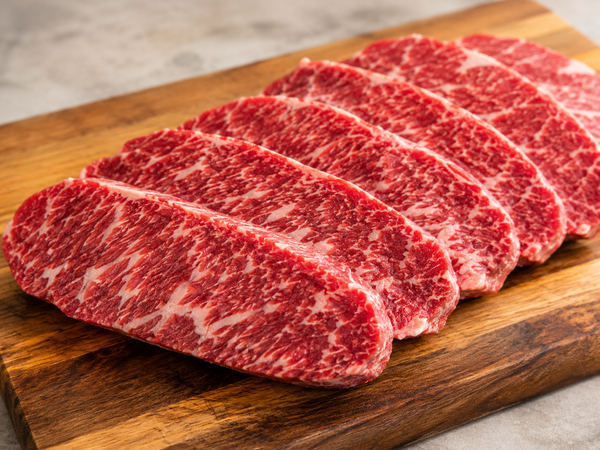
Most Australian cattle spend all or most of their lives on pasture. Some are finished on grain rations for the final months to build consistent marbling, which is why you see both grass fed and grain fed options at the butcher. Breed matters too. Angus dominates the premium end for its reliable marbling, while Australian Wagyu programs produce the highest marble scores in the country. If you are weighing up the two, our guide to Wagyu vs Angus breaks down the difference.
Grass Fed vs Grain Fed Systems
Grass fed cattle graze pasture for life, giving leaner meat with a cleaner, beefier flavour. Grain fed cattle are finished on grain to build marbling and consistency. Neither is wrong; they suit different cooks and budgets. Our grass fed vs grain fed beef guide covers the full comparison.
How Is Australian Beef Quality Graded?

Australian beef is graded on eating quality through Meat Standards Australia (MSA) and on marbling through the AUS-MEAT marble score scale. Between them, these two systems tell you more about a cut than any amount of packaging polish.
Meat Standards Australia is an independent grading program that assesses factors like marbling, maturity and pH, then predicts how tender and flavoursome the beef will actually be to eat. Beef that meets the standard carries an MSA grade, which is the closest thing Australia has to a guarantee of eating quality.
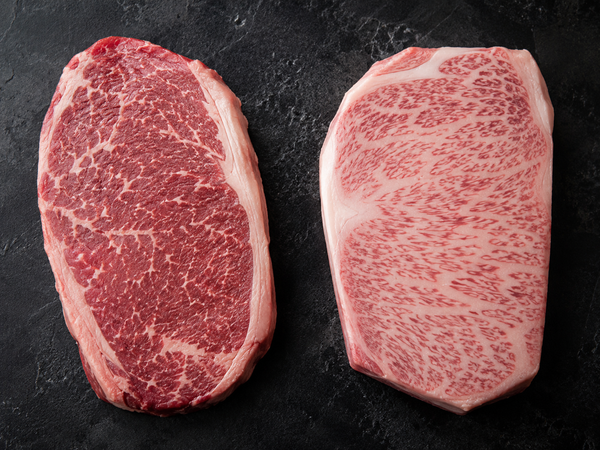
Marble score runs from MB0 to MB9+, measuring the fine ribbons of intramuscular fat that melt through the meat as it cooks. More marbling generally means more flavour and juiciness, and a higher price per kilo. A grass fed Angus scotch fillet might sit around MB2 to MB4, while graded Wagyu climbs from MB2+ towards MB9+.
When you shop, the practical takeaway is simple: look for the grade, not the adjectives. A listing that states its marble score and feeding system is telling you something verifiable. Our full guide to the beef marble score explains how to read it cut by cut.
Why Does the World Trust Australian Beef?
Australian beef is trusted globally because every animal is traceable for life, food safety standards are among the strictest anywhere, and the industry exports to more than 100 markets that audit it constantly.
Traceability is the backbone. Under the National Livestock Identification System (NLIS), every beast carries an electronic tag that records its movements from property of birth to processing. If a question is ever raised about a batch of beef, it can be traced back to its source, something very few countries can do at national scale.
Australia's disease-free status and biosecurity rules add another layer. The country has never had a case of BSE, and its herds graze some of the cleanest pasture country in the world. Around 70% of Australian beef production is exported, according to Meat and Livestock Australia, and demanding markets like Japan, Korea and the EU keep the whole system honest.
Hormone growth promotants are permitted in parts of the industry, but many Australian producers run HGP-free programs, and premium grass fed brands typically raise cattle free of added hormones and antibiotics. It is one more thing worth checking on the label, and one more reason the label actually means something here.
Is Australian Beef Worth the Money?
Yes, Australian beef is worth it when you match the cut and grade to how you actually cook, and the price spread is wider than most shoppers expect. The key is knowing what each tier buys you.
At the value end, cuts like rump and rostbiff from 100% grass fed Angus start around $26/kg, and they deliver serious flavour for weeknight cooking. Mid-tier steak cuts such as porterhouse sit in the low $30s per kilo. Premium scotch fillet runs from about $39/kg to $54/kg depending on grade and source, while eye fillet and whole tenderloin range from around $45/kg to $65/kg. Graded Australian Wagyu starts near $34/kg for MB2+ porterhouse and climbs to $77/kg for bone-in ribeye.
| Tier | Typical cuts | Price guide (AUD) | Best for |
|---|---|---|---|
| Everyday value | Rump, rostbiff, oyster blade | From $26/kg | Weeknight steaks, stir fries, meal prep |
| Premium steak | Porterhouse, scotch fillet, eye fillet | $32 to $65/kg | Steak night, roasts, entertaining |
| Graded Wagyu | Wagyu porterhouse, tenderloin, ribeye | $34 to $77/kg | Occasions, gifts, the best steak you will cook |
Against imported alternatives the comparison is straightforward. American beef is almost entirely grain fed and graded on marbling alone, while Australian beef offers both feeding systems, eating-quality grading through MSA, and lifetime traceability. You are not just paying for a steak, you are paying for a system that can prove what the steak is.
How to Buy Good Australian Beef Online

Buying good Australian beef online comes down to checking four things: the feeding claim, the grade, the source, and the cold chain. A seller doing all four properly will show you, not just tell you.
First, read the feeding claim closely. "100% grass fed and finished" means pasture for life; plain "grass fed" can still allow grain finishing. Second, look for a stated MSA grade or marble score rather than vague words like premium. Third, favour retailers who name their supply brands. At Cost Cut Meats we list ours openly, from Southern Ranges 100% grass fed and finished Angus to AMG grass fed beef and Roam graded Wagyu; you can see the full lineup on our brands page.
Finally, check how it arrives. Beef should ship vacuum sealed in insulated packaging with the cold chain maintained door to door; our guide to how meat delivery works in Australia explains what good looks like. If you want a benchmark for what honest labelling reads like, a cut such as our 100% grass fed scotch fillet states its feeding, source and price per kilo up front. For choosing between cuts, the Australian beef cuts guide covers every option.
Conclusion
Australian beef earns its reputation through pasture, grading and traceability, not slogans. Once you can read a feeding claim, an MSA grade and a marble score, buying well becomes easy. When you are ready to taste the difference, Cost Cut Meats delivers 100% Australian graded beef, farm direct and priced honestly per kilo.