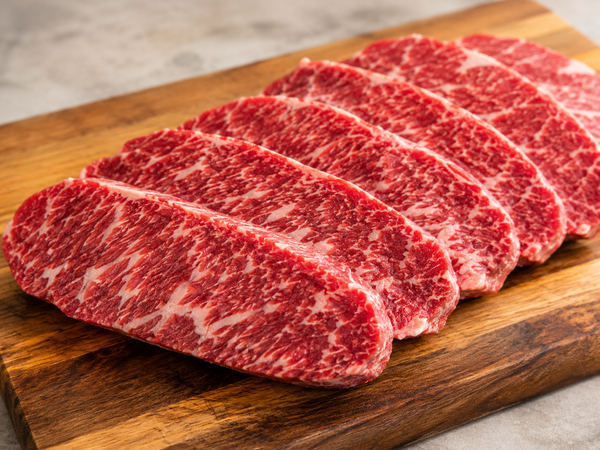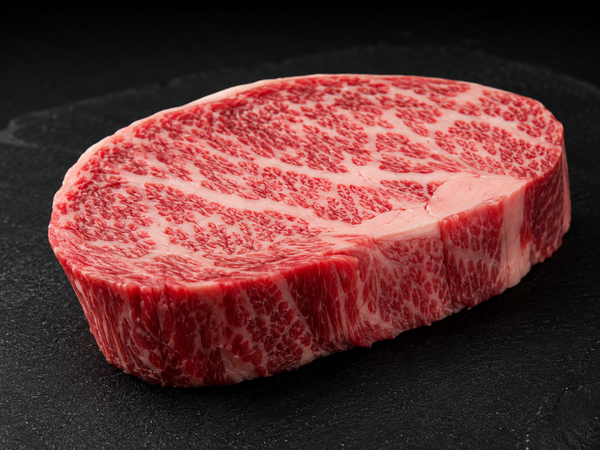

Australian Wagyu and Japanese Wagyu share the same bloodlines but arrive at your plate as noticeably different steaks, at very different prices. The short version: Japan feeds longer, grades tighter and charges accordingly, while Australian Wagyu trades some of that intensity for versatility and value.
This comparison covers the genetics, feeding, grading systems, flavour and real AUD costs, so you can decide which Wagyu actually suits your table instead of paying for the more famous name by default.
Australian and Japanese Wagyu at a Glance
Japanese Wagyu is richer, more regulated and far more expensive; Australian Wagyu delivers most of the experience with more versatility per dollar.
| Factor | Australian Wagyu | Japanese Wagyu |
|---|---|---|
| Genetics | Fullblood herds plus F1 crossbreds (usually Wagyu over Angus) | Purebred Japanese herds, tightly controlled |
| Feeding | Pasture based, often grain finished 300 to 500+ days; grass fed programs exist | Long grain feeding, commonly around 600 days |
| Grading | AUS-MEAT marble score MB1 to MB9+ | Yield A to C plus quality 1 to 5; BMS 1 to 12 |
| Flavour | Beef-forward with rich marbling | Intensely rich, melts through, small serves |
| Price guide (AUD) | From $34/kg (our MB2+ range) | Typically several hundred dollars per kg imported (estimate) |
Genetics: Same Breeds, Different Herds
Both trace to the same Japanese breeds, mainly Japanese Black, but Japan keeps its herds purebred while Australia runs both fullblood and crossbred programs.
Japan treats Wagyu genetics as a national asset, and its herds are closed and closely managed. Australia imported Wagyu genetics in the 1990s and built the largest herd outside Japan, split between fullblood animals descended entirely from those bloodlines and F1 crossbreds, usually Wagyu over Angus.
Crossbreeding is not a shortcut so much as a strategy. F1 animals marble well above ordinary beef while costing far less to produce, which is what makes entry-level Australian Wagyu possible. Fullblood Australian Wagyu sits closer to the Japanese product, and its price reflects that. The label to look for is the breeding claim: fullblood, purebred or crossbred each mean something specific about what you are buying. Our guide to what Wagyu beef is covers the breeds in more detail.
Feeding and Farming Differences
The biggest practical difference is time on feed: Japanese Wagyu is grain fed for around 600 days, roughly double a typical Australian program.
Those extra months are where the extreme marbling comes from. Japanese producers feed slowly and long, building intramuscular fat to levels no other system reaches. Australian Wagyu programs typically finish on grain for 300 to 500 days, still far beyond regular beef, while some producers raise grass fed Wagyu that skips the feedlot entirely for a leaner, cleaner-eating style.
Australia's pasture-first phase also shapes the flavour. Cattle that spend longer grazing develop more beef-forward flavour beneath the marbling, where the Japanese approach prioritises fat quality and uniformity above all. Neither is cutting corners; they are different philosophies about what the perfect steak is.
Grading: A5 and BMS vs the Australian MB Scale

Japan grades Wagyu on yield (A to C) and quality (1 to 5) with a Beef Marbling Standard from 1 to 12; Australia grades marbling on the AUS-MEAT scale from MB1 to MB9+.
A5 means the top yield class and the top quality class, with A5 carcases carrying BMS scores of 8 to 12. The famous names, Kobe among them, are regional certifications layered on top of that system. Australia's MB scale measures the same thing, intramuscular fat, and its top grades approach the marbling of lower A5 territory, though the systems do not convert exactly.
For buyers, the translation that matters is simple: an MB4 Australian Wagyu is a rich but versatile steak, MB8 to MB9+ approaches the Japanese experience, and A5 BMS 10 to 12 is a category of its own, eaten in slices rather than steaks. Our guide to the beef marble score covers how the Australian scale is assessed.
Flavour and Texture: How They Actually Eat
Japanese Wagyu melts through with intense, buttery richness that suits small serves; Australian Wagyu eats like an exceptional steak, rich but still beef-first.
A5 is an experience food. The fat content is so high that 100 to 150 grams satisfies most eaters, and it is best seared quickly in thin slices rather than grilled as a thick steak. Australian Wagyu at MB2 to MB5 behaves like the best conventional steak you have cooked: proper portions, familiar methods, noticeably richer than premium Angus. If you are weighing Wagyu against Angus altogether, our Wagyu vs Angus comparison covers that decision.
Price: What Each Costs in Australia
Australian Wagyu starts around $34/kg for graded MB2+ cuts, while imported Japanese A5 typically costs several hundred dollars per kilogram (estimate).
The gap comes from feeding time, yield and import economics, not just prestige. From our range, a grass fed Wagyu porterhouse MB2+ is $34/kg, a Wagyu tenderloin MB2-3+ is $56/kg, and bone-in Wagyu ribeye is $77/kg. High-grade Australian MB8-9+ typically runs $150/kg and beyond (estimate), still well under landed A5. Per satisfying serve, Australian Wagyu is the value story; A5's small portions soften its sticker shock, but it remains occasion beef.
Which Wagyu Should You Buy?
Buy Australian Wagyu for steaks you cook regularly, and Japanese A5 for once-in-a-while experiences served in small portions.
If you want a better steak night, MB2 to MB5 Australian Wagyu is the rational buy: real Wagyu character, normal cooking methods, prices that do not confine it to birthdays. If you want to understand what the fuss is about, try A5 once, sliced thin and shared. And if you are choosing a cut, the Australian beef cuts guide matches each one to the right method. There is no wrong answer here, only a wrong expectation: they are two different products wearing the same name.
Conclusion
Australian and Japanese Wagyu share genetics and part ways on feeding, grading and price. Japan perfected intensity; Australia made Wagyu something you can actually cook on a weeknight. Match the grade to the occasion and both are worth their money. Cost Cut Meats delivers graded Australian Wagyu from $34/kg nationwide.