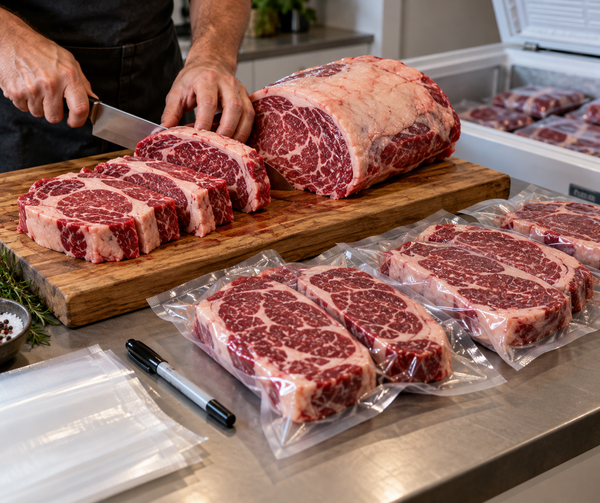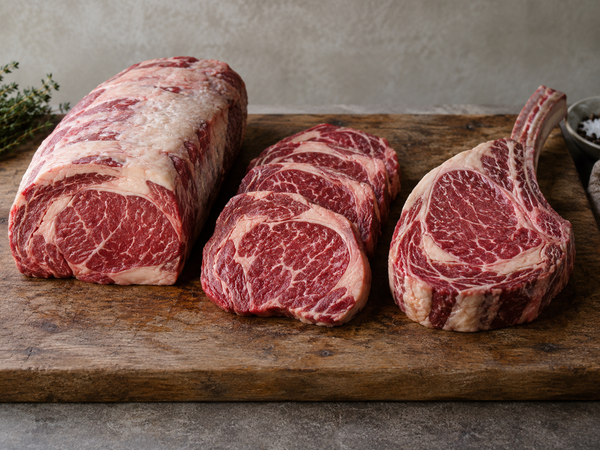

A marble score is the number used to rate the marbling, the fine threads of intramuscular fat running through a cut of beef. In Australia it runs from MB0, with almost no marbling, up to MB9+ for the richest Wagyu, and the higher the score the more buttery, tender and expensive the beef tends to be. This guide explains how the scale works, what each score means on the plate, how it compares to the US and Japan, and exactly what to look for when buying.
What Is a Marble Score?
A marble score measures the marbling inside a cut of beef, meaning the fine flecks of fat held within the muscle rather than the fat around the edge. That intramuscular fat is what gives good steak its richness, so the score is a quick way to judge how a cut is likely to eat before you cook it.
In Australia the score is set under the AUS-MEAT system. Trained graders assess the chilled, cut face of the meat, usually across the eye of a ribeye at a set rib, and give it a number based on how much marbling is visible and how evenly it is spread.
It is worth being clear on what the number does and does not tell you. A marble score speaks to flavour and tenderness potential, not to portion size, breed or how the animal was raised. Two steaks can share a score yet eat differently depending on the cut and how you cook them, which is why the rest of this guide pairs the number with practical buying advice.
Why Marbling Matters
Marbling matters because that intramuscular fat melts as the beef cooks, basting the muscle from the inside and driving flavour, juiciness and tenderness. It is the single biggest reason a well-marbled steak tastes richer than a lean one, even when both are cooked well.
The fat in marbling renders at a lower temperature than the surrounding muscle, so it softens and spreads through the meat during cooking. That keeps the steak moist, carries fat-soluble flavour across the palate, and makes a marbled cut far more forgiving if you push it slightly past your target doneness. Industry research on marbling consistently links higher scores with better eating quality scores from consumers.
Marbling is not the same as a thick outer rim of fat, which you trim and discard. It is also influenced by how cattle are raised, since longer grain finishing builds more marbling, which is why it often differs between grass fed and grain fed beef. That is why marbling, and the score that measures it, sits at the heart of how premium beef is priced and sold.
How the Australian Marble Score Scale Works
Australia uses the AUS-MEAT marbling scale, which runs from MB0 with no visible marbling up to MB9+ for the most heavily marbled Wagyu. The score moves up in single steps, and each step reflects more fat flecking spread more evenly through the eye of the meat.
Most everyday beef sits at the lower end of the scale, while premium and Wagyu beef climbs the top half. Australian Wagyu grading mirrors the Japanese marbling standard closely, and because the AUS-MEAT scale stops at 9, the very highest Wagyu, which would score 10 to 12 in Japan, is shown here as MB9+. Separately, Meat Standards Australia uses an even finer marbling measure inside its broader grading model, but the MB number is the one you will see on most labels.
| Marble score | Marbling level | What you will usually see |
|---|---|---|
| MB0 | None to very light | Standard grass-fed steaks and lean everyday cuts |
| MB1 to MB2 | Light | Good-value steaks with a little fleck through the eye |
| MB3 to MB5 | Moderate to good | Premium Angus, noticeably richer and more tender |
| MB6 to MB9 | Abundant | Wagyu and crossbred Wagyu, heavily marbled |
| MB9+ | Extreme | Top fullblood Wagyu, covering the Japanese 10 to 12 range |
What Each Marble Score Means

As a quick guide, the higher the marble score the richer and more buttery the beef, but the best score for you depends on the cut and how you plan to cook it. The table below maps each band to flavour, the jobs it suits, and a rough price guide for context.
| Marble score | Flavour and texture | Best for | Indicative price guide (AUD) |
|---|---|---|---|
| MB0 to MB1 | Clean, beefy, leaner and firmer | Marinating, braising and everyday midweek steaks | Entry level, from around $25 to $35/kg |
| MB2 to MB3 | Balanced and juicier, still affordable | Weeknight to weekend steaks and the barbecue | Around $35 to $55/kg |
| MB4 to MB5 | Rich, tender and clearly marbled | Special-occasion steaks and premium Angus | Around $55 to $90/kg |
| MB6 to MB7 | Buttery, very tender, starts to melt | Wagyu steaks served in smaller portions | Around $90 to $160/kg |
| MB8 to MB9+ | Intensely rich and almost silky | Fullblood Wagyu shared as a treat | Premium, $160/kg and up |
These ranges are an indicative market guide only, since real pricing moves with the cut, the supplier and current supply. Use the score to set your expectations, then check the cut and the live price before you buy.
Marble Score vs MSA Grading: What Is the Difference?
A marble score measures only the marbling in a cut, while Meat Standards Australia grading predicts the whole eating quality of that cut, with marbling as just one input. The two are related, but they answer different questions.
The marble score tells you how rich a steak is likely to be. The MSA model goes further, weighing marbling alongside factors such as the maturity of the animal, pH, how the meat was hung and aged, and even the specific cut and cooking method, to predict tenderness, juiciness and flavour. The result is a cut-by-cut eating-quality grade rather than a single fat number.
For a buyer, the simple way to hold both in your head is this. The marble score answers how rich, and MSA grading answers how good the overall eating experience should be. All beef at Cost Cut Meats is MSA graded, so you get the reassurance of that wider quality check on top of the marble score you can see.
How Australian Marble Scores Compare to the US and Japan
Australia's marble score lines up closely with Japan's BMS scale and sits well above the US system at the top end. If you buy beef from different countries, or compare labels online, it helps to know roughly how the three systems line up.
Australian AUS-MEAT scores broadly match the Japanese Beef Marbling Standard, so an Australian MB5 is close to a Japanese BMS 5. The US system is simpler, topping out at Prime, which sits roughly around the lower marbled end of the Wagyu range. The table below is an approximate guide, since each country measures slightly differently.
| Australia (AUS-MEAT MB) | Japan (BMS) | United States (USDA) |
|---|---|---|
| MB0 | BMS 1 | Select |
| MB1 to MB2 | BMS 2 | Choice |
| MB3 to MB4 | BMS 3 to 4 | Prime |
| MB5 | BMS 5 | Beyond Prime / Wagyu |
| MB6 to MB9 | BMS 6 to 9 | American Wagyu range |
| MB9+ | BMS 10 to 12 | Top Wagyu only |
The takeaway is that a top US Prime steak is genuinely good, but it is closer to a moderate Australian or Japanese marble score than to true high-end Wagyu. Breed plays a big part too, as we cover in our look at how Wagyu and Angus compare.
What to Look For When Buying
When buying, match the marble score to the cut and the cooking method rather than always chasing the highest number. The right score is the one that suits the meal and your budget, not simply the most marbled steak in the cabinet.
A few practical checks make the choice easier:
- Look at the eye of the meat: fine, even, web-like flecks eat better than a few thick streaks of fat.
- Back marbling for quick-cook steaks: cuts like scotch fillet, ribeye and rump reward a higher score when seared hot and fast.
- Save money on slow dishes: for braises, marinades and casseroles a lower score is fine and better value, so it is worth knowing the cheaper beef cuts worth buying.
- Mind your portion: the higher the score the richer the beef, so very high Wagyu is best served in smaller pieces or shared.
- Check the grading: a clear MB number and MSA grading beat vague wording like premium or gourmet with no score attached.
If you are buying for the grill, our roundup of the best steak for a BBQ pairs scores with cuts that handle high heat well.
Which Cuts Show Marbling Best

Marbling shows up most in cuts from the rib and loin, which is why scotch fillet and ribeye are the classic high-marble steaks. These muscles do less work, so they hold more fine intramuscular fat and carry a high score beautifully.
The scotch fillet, OP rib and ribeye are the cuts where a strong marble score pays off most, followed by striploin and porterhouse, then well-marbled rump cap. Leaner cuts such as eye fillet carry less marbling by nature, so they rely on tenderness rather than richness. Cuts from the chuck and brisket have more connective tissue than fine marbling, so they suit low and slow cooking instead.
As a rule, cook well-marbled steaks hot and fast to render the fat and build a crust, and keep connective-tissue cuts low and slow. If you want the richest end of the scale, browse our Wagyu range or the heavily marbled options in our scotch and rib fillet selection.
Conclusion
A marble score is simply a guide to how rich and tender a steak will be, from lean MB0 right up to melt-in-the-mouth MB9+ Wagyu. Match the score to the cut, the cooking method and your budget, and you will buy with confidence every time. Browse our MSA-graded beef at Cost Cut Meats to put it into practice.