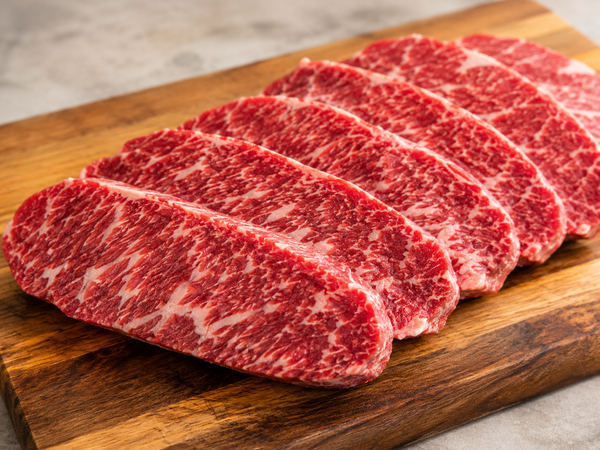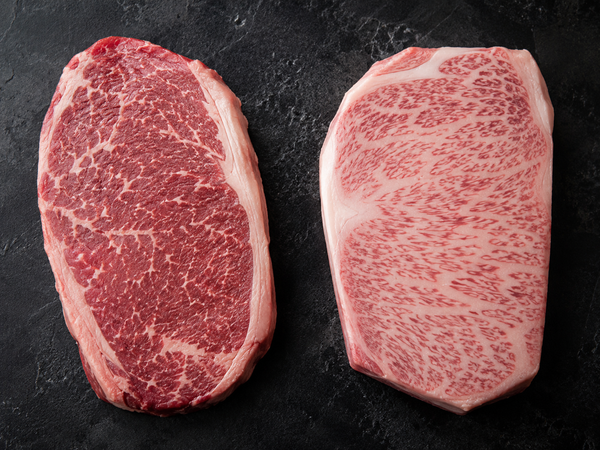

Wagyu beef has become shorthand for the best steak money can buy, but what is Wagyu beef actually, and why does one steak cost three times another with the same name on it? The answers sit in genetics, feeding and grading.
This guide explains where Wagyu comes from, why it marbles the way it does, how the Australian MB scale and Japanese A5 system work, and how to buy graded Wagyu online without overpaying for the word alone.
What Does Wagyu Actually Mean?
Wagyu literally means Japanese cow, and it refers to specific Japanese cattle breeds prized for intense intramuscular marbling, not to any beef that eats richly.
Four breeds qualify as Wagyu in Japan, and one of them, the Japanese Black, accounts for the vast majority of Wagyu worldwide. These cattle carry a genetic tendency to lay down fat inside the muscle rather than around it, which is the marbling that defines the category.
Wagyu genetics arrived in Australia in the 1990s, and the country has since built the largest Wagyu herd outside Japan. Australian producers breed fullblood herds descended entirely from Japanese genetics as well as crossbred programs, most commonly Wagyu over Angus. That mix is why Australian Wagyu spans such a wide range of quality and price, and why the grading on the label matters more than the name.
Why Is Wagyu So Marbled?
Wagyu marbles intensely because of genetics amplified by long, slow feeding: the breed lays down fat within the muscle, and extended grain feeding gives it time to build.
Marbling is intramuscular fat, the fine white seams that melt through the meat as it cooks. In most breeds it develops modestly. Wagyu cattle convert feed into intramuscular fat far more readily, and producers feed them for much longer than standard cattle, often 350 to 500 days or more on grain compared with around 100 for regular grain fed beef.
That melted fat is what you taste. Wagyu fat also has a lower melting point than standard beef fat, which is why it reads as buttery on the palate rather than greasy. The result is a steak that is richer per bite, best served in smaller portions, and fundamentally different to eat than even a top Angus cut. If you want the full breed comparison, our Wagyu vs Angus guide covers it.
How Is Wagyu Graded?

Australian Wagyu is graded on the AUS-MEAT marble score scale from MB1 to MB9+, while Japanese Wagyu uses the A1 to A5 system with a Beef Marbling Standard from 1 to 12.
The number is the single most useful thing on a Wagyu label. It tells you how much intramuscular fat the cut carries, and therefore how rich it will eat and roughly what it should cost. Our guide to the beef marble score explains how graders assess it.
| Grade | System | What it means | Price guide (AUD) |
|---|---|---|---|
| MB2 to MB4 | Australian | Entry Wagyu, noticeably richer than Angus | From $34/kg (our range) |
| MB5 to MB7 | Australian | Special occasion richness | Roughly $80 to $150/kg (estimate) |
| MB8 to MB9+ | Australian | Ultra premium, near Japanese levels | $150/kg and up (estimate) |
| A5 (BMS 8 to 12) | Japanese | Maximum marbling, imported | Typically several hundred dollars per kg (estimate) |
Fullblood vs Purebred vs F1 Crossbred
Fullblood Wagyu descends entirely from Japanese genetics. Purebred is bred back to near-full Wagyu content, and F1 crossbred is a 50% cross, usually Wagyu over Angus. Crossbreds deliver real Wagyu character at far friendlier prices, which is most of what Australia produces.
Japanese vs Australian Wagyu: The Short Version
Japanese Wagyu is richer, more regulated and far more expensive; Australian Wagyu trades some intensity for versatility and value. Japan feeds longer and grades tighter, so A5 eats like nothing else, in small amounts. Australian Wagyu, especially MB2 to MB5, behaves more like an exceptional steak you can actually cook regularly. We cover the full head-to-head in our Australian Wagyu vs Japanese Wagyu comparison.
Is Wagyu Worth the Money?
Wagyu is worth it when the grade matches the occasion: entry-level MB2 to MB4 is a justifiable everyday upgrade, while high grades are occasion beef best bought in small portions.
At the entry level, the maths is friendlier than most people expect. A graded MB2+ Wagyu porterhouse at $34/kg costs about the same as a premium grass fed porterhouse, and eats noticeably richer. That is the sweet spot for a regular steak night upgrade.
Higher grades change the equation. Past MB6 or so, richness climbs faster than enjoyment for many eaters, and portion sizes shrink; 150g of MB9 goes further than 300g of it. Buy high grades for moments, not meals. And whatever the grade, the same rule from the rest of our range applies: a listing should state its marble score and price per kilo plainly, the way our bone-in Wagyu ribeye does.
How to Buy Wagyu Online in Australia

Buying Wagyu online well means checking the marble score, the breeding (fullblood or crossbred), the feeding claim and the per-kg price, in that order.
Start with the marble score, because Wagyu without a stated grade is just a word. Then look for the breeding: fullblood commands a premium, while F1 crossbred delivers most of the experience for less. Feeding matters too; grass fed Wagyu like our Roam range eats cleaner and slightly leaner than long-fed feedlot Wagyu at the same grade.
From our range, a grass fed Wagyu porterhouse MB2+ starts at $34/kg, a Wagyu tenderloin MB2-3+ at $56/kg, and the bone-in ribeye at $77/kg. Match the cut to the cook the same way you would any steak; the Australian beef cuts guide covers which cut suits which method.
Conclusion
Wagyu is special because genetics, feeding and grading combine to produce marbling no other beef can match. The label only means something with a marble score next to it, so buy the grade, match it to the occasion, and start at MB2+ if you are new to it. Cost Cut Meats delivers graded Australian Wagyu nationwide.