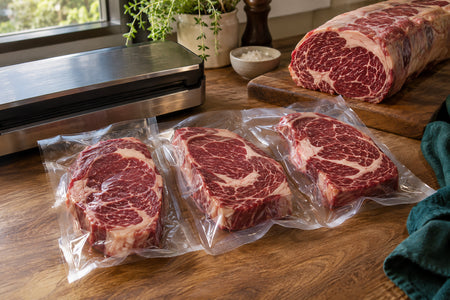

Knowing how to organise a chest freezer turns a bulk beef order into easy dinners: run it at -18C or colder, portion and freeze meat flat, sort it into zones by cut, label every pack and keep an inventory list.
If you have just ordered one of our bulk beef packs or a whole primal, most of the work happens before anything goes in. Set it up properly on day one and it stays easy to use.
Below are the steps, plus a freezer inventory list to copy and what to do if the power goes out.
Set Your Chest Freezer to -18C or Colder
Set your chest freezer to -18C or colder before any meat goes in. The Food Safety Information Council recommends keeping frozen food at -18C or below, which is the normal operating temperature for a home freezer.
Many dials use numbered settings rather than degrees, so a freezer thermometer is the only way to know where yours sits. Place it among the packs, check it the next day and adjust if needed.
If the freezer is new or freshly defrosted, let it reach temperature before a delivery goes in.
Portion Bulk Beef Before It Goes In

Portion bulk beef into meal-sized packs before freezing, because a frozen primal is almost impossible to divide at home without thawing it first.
Our beef is sold as whole primals and large pieces, so this step is where good chest freezer organisation really starts. A scotch cube roll becomes a stack of steaks once you cut the scotch fillet into even portions. Learning to cut rump steak from a whole rump gives you steaks, a roast and stir fry strips.
Pack each portion for one meal, so two steaks for two people rather than six in one bag. Air contact is what leads to freezer burn, so vacuum seal each pack or press the air out of a zip-lock freezer bag before sealing it.
Freeze Packs Flat
Flat packs freeze faster, stack neatly and thaw more evenly than thick bundles. Lay steaks side by side in a single layer and spread stir fry strips thinly. Once frozen solid, flat packs stand on edge in a crate like files, so you can flick through to the cut you want.
How to Organise a Chest Freezer by Zone

The simplest way to organise a chest freezer is to give each cut and each meal type its own zone, with the packs you reach for most kept at the top.
Chest freezers are deep, and whatever sits at the bottom tends to be forgotten, so put bulky, occasional items such as roasts in the lowest layer.
| Zone | What goes in | Where it sits |
|---|---|---|
| Use first | Older packs and anything planned for the next week or two | Hanging basket or top front |
| Steaks | Scotch fillet, eye fillet, porterhouse and rump steaks, packed flat | Top layer |
| Stir fry and trim | Rump strips, diced beef and trim saved for stock or jerky | Middle layer |
| Roasts | Rump cap, rostbiff, and eye fillet or scotch fillet roasting pieces | Bottom layer |
| Cooked meals | Batch-cooked meals, stocks and sauces | Top layer, above raw meat |
Keep cooked and ready-to-eat food above raw packs, so raw juices cannot drip onto it if anything starts to thaw.
Baskets, Crates and Dividers
The most useful chest freezer storage ideas are simple containers that turn one deep space into layers. If your freezer has a hanging basket, make it the use-first zone, then organise chest freezer space below with open crates or bins, one per zone and labelled on the end. Lift a whole crate out to reach the layer underneath, and use a divider to split one crate into two smaller zones.
Label Every Pack With Cut, Weight and Date
Label every pack with the cut, its weight and the date it went into the freezer. Use a permanent marker or a freezer label on the flat face of the bag, so you can read it when packs stand on edge. Add the number of portions, and note whether a pack is marinated or seasoned.
Write the date frozen rather than the date bought, because how long you can freeze meat for best quality depends on when it actually went in.
Label bags before freezing, as marker and stickers struggle on frosty plastic.
Rotate Stock With First In, First Out
First in, first out means the oldest packs get eaten first, so nothing sits in the freezer long enough to lose quality. When a new delivery is portioned, move older packs into the use-first zone or to the front of their crate, then put the new packs behind or beneath them.
Move the next pack into the fridge in good time, since thawing in the fridge is the safest way to defrost meat, and cross it off your inventory list.
Keep a Freezer Inventory List

A freezer inventory list shows what is in the freezer without opening the lid and digging. Keep it on the lid or in a shared phone note, and update it whenever a pack goes in or comes out.
Copy this template and add a row for each cut you store:
| Cut | Zone | Pack size and weight | Packs in | Date frozen | Used (tally) |
|---|---|---|---|---|---|
| Scotch fillet steaks | Steaks | ||||
| Rump steaks | Steaks | ||||
| Rump strips | Stir fry and trim | ||||
| Rump cap roast | Roasts | ||||
| Cooked meals | Cooked meals |
A quick look shows what to cook first and when a zone is running low.
Don't Overload the Freezer With Unfrozen Meat
Freeze a large delivery in batches, because loading too much unfrozen meat at once means it takes longer to freeze through.
Many freezers list a freezing capacity on the rating plate or in the manual, shown in kilograms per 24 hours. That figure is the most fresh food the freezer can freeze through in a day, so keep each batch under it.
Our beef arrives chilled rather than frozen, so a big order needs freezer space all at once. Keep the packs waiting their turn in the fridge, lay each batch in a single layer with space between packs, and stack them once they are frozen solid. If your freezer has a fast-freeze setting, check the manual for when to switch it on.
How to Defrost and Clean a Chest Freezer

Unless your model is frost-free, defrost a chest freezer whenever ice build-up starts taking up space or stops the lid sealing properly. The easiest time is when stock is low, just before your next bulk order.
- Switch off and unplug the freezer.
- Pack the meat tightly into eskies or cooler bags with frozen ice bricks, or into a second freezer if you have one, and keep the lids shut.
- Prop the lid open, lay towels around the base and use the drain plug if your model has one.
- Let the ice melt. Never chip at it with a knife or other sharp tool, as you can damage the lining.
- Wash the inside, baskets and crates with warm water and a little bicarb soda, then dry everything thoroughly.
- Switch the freezer back on, close the lid and wait until the thermometer reads -18C or colder before reloading.
Reload zone by zone and refresh your inventory list while everything is out.
What to Do in a Power Outage
Keep the lid closed during a power outage, since every opening lets cold air escape. WA Health advice is that, with the door kept shut, a full freezer can keep food frozen for up to 48 hours and a half-full freezer for 24 hours, so a well-stocked freezer is better placed to ride out an outage.
Note the time the power goes off, then check the meat when it returns, ideally with a thermometer, and use the same guidance:
| Condition of the meat | What to do |
|---|---|
| Partly or fully thawed but still at 5C or below | It can be refrozen, though quality may drop |
| Above 5C for up to 2 hours | Refreeze it, move it to a fridge running below 5C, or cook it straight away |
| Above 5C for 2 to 4 hours | Cook and eat it straight away |
| Above 5C for more than 4 hours | Throw it out |
Conclusion
Organising a chest freezer is mostly a one-off job: set it to -18C, portion and freeze flat, zone by cut, label every pack and keep the list current.
That system is also what makes buying meat in bulk pay off, since nothing gets lost at the bottom or wasted.
Then every whole primal from Cost Cut Meats becomes labelled, easy-to-find dinners.