
Ask two Australian butchers for the same steak and one will call it sirloin while the other calls it porterhouse. Both are right.
The sirloin vs porterhouse question has a short answer in this country, and a longer one that explains why imported recipes and overseas menus keep confusing people.
This guide covers what the cut actually is, where it sits on the animal, why the American porterhouse is a different steak entirely, and how the striploin compares to rump, scotch fillet and eye fillet.
Sirloin vs Porterhouse: The Short Answer
In Australia, sirloin and porterhouse both describe the boneless striploin, a single muscle taken from the beef middle, and the two names are used interchangeably by butchers, supermarkets and restaurants.
There is no difference in the meat, the grade, the price bracket or the cooking method. The variation is regional and historical rather than anatomical. Some Australian butchers lean towards porterhouse, some towards sirloin, and plenty of shops use both on the same board.
Where it gets messy is that the same words mean different things overseas. The table below maps the Australian names to their American and British equivalents, which is where almost every misunderstanding starts.
Australian name |
Also called in Australia |
United States |
United Kingdom |
What it actually is |
Porterhouse |
Sirloin, striploin |
New York strip, strip loin |
Sirloin steak |
The boneless striploin muscle |
T-bone |
Bone-in sirloin |
T-bone, or porterhouse when the fillet section is large |
T-bone |
Striploin and tenderloin either side of the bone |
Rump |
Rump steak |
Top sirloin |
Rump |
A separate cut from the hip |
Scotch fillet |
Rib fillet, and cube roll when sold whole |
Ribeye |
Ribeye |
From the rib primal, not the loin |
Eye fillet |
Tenderloin |
Tenderloin, filet mignon |
Fillet |
The tenderloin muscle |
Where the Striploin Sits on the Animal
The striploin runs along the back of the animal in the beef middle, sitting behind the rib and in front of the rump, with the tenderloin tucked underneath it on the other side of the backbone.
Because it is a muscle that supports rather than moves, it stays tender without being as soft as the eye fillet. It carries a firm fat cap along one edge and a moderate amount of intramuscular fat through the muscle itself, which is where its flavour comes from.
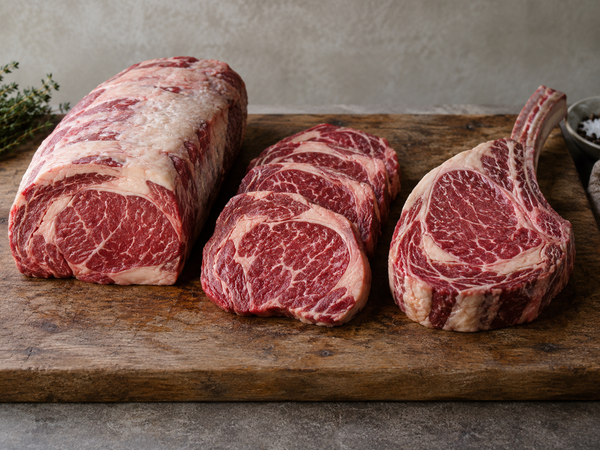
That position also explains the T-bone. If the butcher saws through the loin with the bone left in, you get the striploin on one side of the T and a section of tenderloin on the other. Take the bone out and separate the two muscles, and you have a porterhouse steak and an eye fillet.
Our Australian beef cuts guide maps where each primal sits if you want the full picture.
Why the American Porterhouse Is a Different Steak
In the United States, a porterhouse is a bone-in steak carrying both the striploin and a large section of tenderloin, which Australians would call a T-bone.
This is the trap. An American porterhouse can weigh 700g or more and holds two muscles that cook at different rates, so American recipes call for indirect heat, longer times and often a finish in the oven. An Australian porterhouse is a single boneless muscle, usually 250g to 400g and 2cm to 3cm thick, and needs a hot pan and a few minutes.
Follow an American porterhouse recipe on an Australian steak and you will overshoot by a long way. If you want the closest Australian equivalent to what an American cook means, buy a T-bone, not a porterhouse.
How Sirloin Compares to Rump, Scotch Fillet and Eye Fillet

Porterhouse sits between rump and scotch fillet: more tender and more marbled than rump, leaner and firmer than scotch fillet, and less soft but more flavoursome than eye fillet.
Cut |
Tenderness |
Marbling |
Price from, at the largest box size |
Best for |
Porterhouse (sirloin) |
Very good |
Moderate, plus a fat cap |
$32/kg |
Grilling and pan searing |
Rump |
Good |
Light |
$26/kg |
Everyday steaks, value |
Rump cap (picanha) |
Good |
Moderate, thick fat cap |
$28/kg |
Barbecue roasting |
Scotch fillet |
Excellent |
Heavy, through the muscle |
$39/kg |
Rich flavour, pan searing |
Eye fillet |
Highest |
Very light |
$45/kg |
Whole roasts, occasions |
Those prices are the entry point at the largest box size. Smaller boxes of the same cut cost more per kilogram, which is worth factoring in before comparing against a supermarket shelf price.
The honest verdict is that porterhouse is the best all-rounder of the five. It has enough fat to stay juicy on a barbecue, a firm bite that reads as steak rather than butter, and a price that sits well below scotch fillet and eye fillet. If you want the softest possible texture, buy eye fillet. If you want the most flavour per bite, buy scotch fillet. For most dinners, porterhouse wins.
What to Look For When Buying Sirloin or Porterhouse

Buy it cut at 2.5cm to 3cm thick, with an even fat cap of roughly 5mm to 10mm and a fine, tight grain.
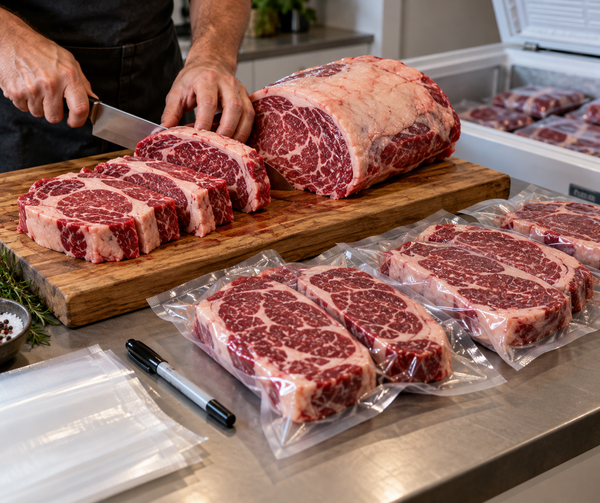
Thickness is the specification that matters most and the one most often ignored. A 2cm steak gives you almost no margin between rare and medium, while a 3cm steak takes a proper crust and stays pink in the middle. Buying the whole striploin and cutting your own steaks solves this for good, and it is the cheaper route by some distance.
MSA grading gives you a reliable floor on eating quality across Australian beef, and marble score tells you how much intramuscular fat to expect. On a striploin, a marble score of 2 or above eats noticeably better than an ungraded steak, though this cut will never carry the marbling of a rib cut. Grass-fed and grain-fed both work here, with grain-fed generally showing more fat through the muscle.
Names on the label are the last thing to worry about. Whether it says sirloin, porterhouse or striploin, check the thickness, the fat cap and the grade instead. You can see the current range in the porterhouse collection, where whole striploin starts from $32/kg.
How to Cook It
Render the fat edge first, then sear 2 to 3 minutes per side for a 2.5cm steak and rest for five minutes.
Porterhouse is lean enough to punish overcooking and fatty enough to reward a hard sear, so heat matters more than technique. Get the pan or grill plate genuinely hot, stand the steak on its fat edge for 60 to 90 seconds before laying it flat, then turn it once. Take it off at 49C for medium rare, since it will climb around 3C while resting. Our full guide to cooking porterhouse steak covers the pan and barbecue methods in detail.
It is also one of the better cuts for a barbecue, holding up to the grill without drying out the way a leaner steak can. Our guide to the best steak for a BBQ covers how it compares to the other options on the grill.
Conclusion
Sirloin and porterhouse are the same steak in Australia, so buy on thickness, fat cap and grade rather than on the name. It is the best value all-rounder in the beef middle and the one steak that suits almost any cooking method. See the current porterhouse range.