
Meat prices in Australia are still rising: the ABS reported beef and veal prices up 13.3% in the 12 months to May 2026, and an AMIC analysis reported on 2 September 2026 put average retail beef at $29.69/kg.
This page sets out those figures in plain words, with every source and date shown.
It covers how fast prices have risen and why, what the main beef cuts cost per kilo by the box, and how to pay less.
How Much Have Meat Prices Gone Up in Australia?

Beef and lamb have risen far faster than meat overall: in the 12 months to May 2026, beef and veal rose 13.3% and lamb and goat 14.8%, against 5.4% for meat and seafood.
In its May 2026 Consumer Price Index, the ABS put the rise down to strong overseas demand for Australian red meat.
| ABS category | Annual change | Period | ABS release |
|---|---|---|---|
| Meat and seafood | Up 5.4% | 12 months to May 2026 | 24 June 2026 |
| Beef and veal | Up 13.3% | 12 months to May 2026 | 24 June 2026 |
| Lamb and goat | Up 14.8% | 12 months to May 2026 | 24 June 2026 |
| Food and non-alcoholic beverages | Up 3.0% | 12 months to August 2026 | 30 September 2026 |
| All groups CPI | Up 4.0% | 12 months to August 2026 | 30 September 2026 |
Retail prices tell the same story. An AMIC analysis reported by Beef Central on 2 September 2026 found average retail beef rose 8.7% between 2025 and 2026.
| Meat | Average retail price, 2025 | Average retail price, 2026 | Change |
|---|---|---|---|
| Beef | $27.32/kg | $29.69/kg | Up 8.7% |
| Lamb | $20.18/kg | $21.89/kg | Up 8.5% |
| Pork | $15.03/kg | $15.19/kg | Up 1.1% |
| Chicken | $6.59/kg | $6.63/kg | Up 0.6% |
An average can hide a wide spread between cuts, so the next section breaks prices down for the premium beef cuts most buyers compare.
What Beef Cuts Cost by the Box
At Cost Cut Meats, beef sold by the box ranges from $23/kg for rump and rump cap in a double box to $82/kg for bone-in Wagyu rib eye steaks in a half box, prices checked 18 October 2026.
The table shows the price range for each cut across our product lines and box sizes.
| Cut | Cost Cut Meats box price per kg | Notes |
|---|---|---|
| Scotch fillet (rib eye) | $34 to $64 | Whole cube roll, four lines |
| Porterhouse (sirloin) | $27 to $50 | Whole striploin, three lines |
| Eye fillet | $42 to $75 | Whole tenderloin, three lines |
| Rump | $23 to $36 | Whole rump or rostbiff |
| Rump cap (picanha) | $23 to $38 | Whole muscle, two lines |
| Bone-in rib eye | $72 to $82 | Roam Wagyu steaks, individually vacuum sealed |
Every figure comes from our live product pages, from the largest box to the smallest order.
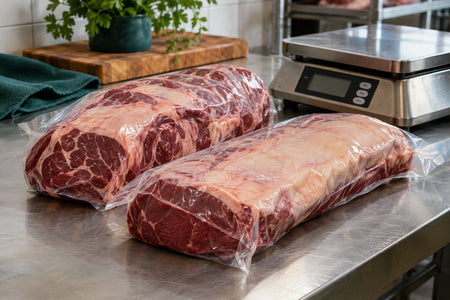
These are not like-for-like numbers with a supermarket steak. Apart from the rib eye steaks, Cost Cut Meats sells whole primals that you portion at home, so the price per kilo includes trim you cut away, while a supermarket steak is already portioned.
Before you set a box against the shelf, compare online butcher versus supermarket prices per usable kilo, after trim and delivery.
Why Is Meat So Expensive in Australia Right Now?
Meat is expensive mainly because the animals cost more: AMIC's analysis found beef livestock prices rose 12.5% and trade lamb 16.4% between 2025 and 2026, and retail prices followed.
The same analysis concluded that the red meat increases were being driven from the farmgate up, rather than by wider margins at the retail end. Pork and chicken barely moved by comparison, with retail pork up 1.1% and chicken up 0.6%.
Demand from overseas adds pressure. The ABS linked the rise in beef, veal, lamb and goat prices in the year to May 2026 to strong overseas demand for Australian red meat.
Then come the costs between paddock and plate. AMIC lists processing, freight, wages, packaging and rent as the costs that sit between the farmgate and the final customer, and every one of them has to be recovered at the counter.
Because retail beef is being driven by livestock values, cattle prices in Australia are the number to watch for where beef prices head next.
Why Some Cuts Cost More Than Others

A cut's price band is set mostly by how tender it is, how much of it each carcase yields and how many people want it, and grade, feed and supplier then move it within that band.
Eye fillet sits at the top of our range, at $42 to $75/kg, because it is the most tender muscle and each side of the carcase gives only one. Rump sits at the bottom, at $23 to $36/kg, because it works harder and eats firmer.
Within a cut, MSA grading and marble score both signal eating quality, so check whether a higher price comes with a stated grade.
Feed matters too, since the difference between grass fed versus grain fed beef shows up in flavour and marbling. Breed is not the whole story either: in our range, the Southern Ranges SR+ Angus porterhouse costs more per kilo than the Roam grass-fed Wagyu porterhouse at every box size.
How to Pay Less per Kilo
The two levers are the cut you choose and the size of your order: a cheaper cut or a bigger format lowers the price per kilo, and doing both lowers it most.
At Cost Cut Meats, a single piece costs $10/kg more than a full box and a half box $5/kg more, while a double box costs $3 to $5/kg less. Delivery is $30 flat and free on orders of $600 or more, to every state and territory except the NT.
Our bulk packs and whole primals list every cut at each box size, so you can see the price per kilo before you commit to the freezer space.
If the cut matters less than the cost, the cheapest beef cuts still cook beautifully when you match them to the right method.
Butchers, supermarkets and online shops all have their place, and where to buy cheap meat depends on the cut and how much you need.
How These Prices Were Checked
Every figure on this page carries its source and date. Cost Cut Meats prices are list prices on one stated day, and the market figures come from the releases named below.
- Market figures: the ABS Consumer Price Index and the AMIC retail price analysis reported by Beef Central, each with its release date.
- Cost Cut Meats prices: list box prices from the live product pages, checked 18 October 2026.
- Supermarket prices: not listed, because they vary by retailer, store and week.
Conclusion
Meat prices in Australia have climbed fastest for beef and lamb, and average retail beef reached $29.69/kg in the AMIC figures reported on 2 September 2026.
A cheaper cut or a bigger box is the surest way to bring your own price per kilo down.
Our premium beef is sold by the box and delivered chilled to every state and territory except the NT.