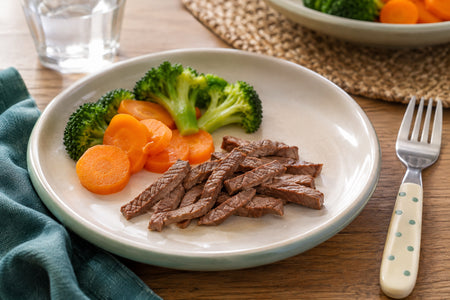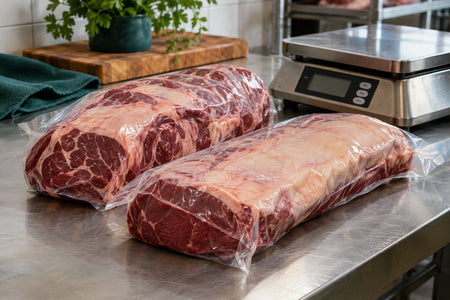

The best beef for stir fry is a lean, beefy cut that holds together when sliced thin across the grain, and for most home cooks that means rump or rostbiff.
Scotch fillet, porterhouse and eye fillet all work too, but each brings a different texture and a higher price per kg.
Below, the four cuts we stock are compared on flavour, fat and price, alongside flank and skirt, with how to slice beef so it stays tender in a hot wok.
What Is the Best Beef for Stir Fry?
Rump is the best all-round beef for stir fry: it has strong flavour, little fat to trim and a lower price per kg than loin and rib cuts, and it stays tender when sliced thin and cooked fast.
Australian eating-quality data backs this up. In Meat Standards Australia research, a rump muscle MSA calls the eye rump side scored 61 as a stir fry against 53 when grilled.
Cost Cut Meats sells rump steak as a whole rump or as rostbiff, so you slice the strips yourself to the thickness and grain you want. Rostbiff is the simplest place to start.
| Cut | Flavour | Fat | Best dishes | From, per kg (full box) |
|---|---|---|---|---|
| Rump and rostbiff | Strong, beefy | Lean | Beef and broccoli, Mongolian beef | $26 |
| Porterhouse (sirloin) | Clean, beefy | Fat edge to trim | Classic stir fries | $32 |
| Scotch fillet | Rich, juicy | Well marbled | Bulgogi and shaved beef dishes | $39 |
| Eye fillet | Mild | Very lean | Quick, gentle stir fries | $45 |
Prices are the lowest full box price per kg for each cut, all AMG grass-fed Angus (prices checked 18 October 2026).
The Four Stocked Cuts Compared for Stir Fry
Here is how the four stocked cuts compare for stir fry, in order of price per kg, from everyday value to special occasion.
Rump and Rostbiff
Rump is lean and beefy, and the AMG grass-fed Angus rostbiff, the rump centre with the cap off, is the easiest piece to slice evenly. A whole rump holds several muscles whose grain runs in different directions, so results vary with the muscle and the slice, which is why cooks rate rump so differently.
Porterhouse (Sirloin)
Porterhouse has an even grain and a clean beef flavour, and it sits between rump and scotch fillet on price. Trim off the fat edge before slicing so the strips cook evenly, then treat it like rump in the wok.
Scotch Fillet
Scotch fillet is the richest and juiciest option, thanks to its marbling, though it costs more per kg than rump or porterhouse.
That richness shines when it is shaved very thin, as in Korean beef bulgogi.
Eye Fillet
Eye fillet is the most tender of the four, and the same MSA data rates tenderloin highly as a stir fry, but it is mild in flavour and the dearest per kg. If you buy a whole fillet, the thinner tail end, too narrow for neat steaks, is the natural piece to slice for the wok.
What About Flank, Skirt and Chuck?
Flank and skirt are the stir fry cuts many overseas recipes call for, but they are less common at Australian butchers and are not part of the Cost Cut Meats range of whole grass-fed primals.
Flank comes from the belly and skirt from the diaphragm area. Both are thin, open-grained cuts that take marinades well and must be sliced thinly across the grain, which is why so many overseas stir fry recipes call for them.
Chuck, blade and shin carry far more connective tissue. The MSA research above explains that slow, moist cooking breaks that tissue down, which is why these cuts suit casseroles, and why shin is the cut Australians know as gravy beef.
In a fast stir fry, those cuts need thin slicing and velveting to stay tender, and gravy beef is better kept for slow-cooked curries and casseroles than for the wok.
For an Australian home cook following an overseas recipe, rump or rostbiff is the closest everyday swap for flank, and a US recipe that calls for sirloin usually means top sirloin, which is closer to Australian rump.
How to Slice and Prepare Beef for Stir Fry
Slice partly frozen beef thinly across the grain, then sear it in small batches in a smoking-hot wok.
- Partly freeze. Firm the piece in the freezer for clean slicing; our stir fry recipes use 20 to 45 minutes.
- Find the grain. Look for the lines of muscle fibre; on a whole rump they change direction, so separate the muscles first.
- Slice across it. Cut strips across the grain; our recipes range from 3mm to 5mm, and shaved dishes such as bulgogi go thinner.
- Marinate briefly. Thin strips need far less time than whole steaks when marinating beef: 30 minutes to 2 hours.
- Sear in batches. Cook the beef in small batches in a smoking-hot wok so it browns rather than stews, then return it for the final minute, as in a classic beef stir fry.
In that recipe, strips this thin reach medium, 65 to 70C, within a minute or two, above the 63C with a 3 minute rest the Food Safety Information Council recommends for whole cuts.
Velveting with Cornflour and Bicarb
Velveting coats strips in cornflour and soy, often with a pinch of bicarbonate of soda, so they stay soft in fierce heat. Our recipes use 1/4 to 1/2 tsp of bicarb for 500g of beef; more tastes soapy. Cornflour alone gives crispy Mongolian beef its crunch.
Buying Beef for Stir Fry: Whole Piece or Pre-Cut Strips?
Buying a whole piece and slicing it yourself usually gives better stir fry beef than pre-cut strips, because you control the thickness and the grain.
Pre-cut strips are often cut too thick or along the grain, which is why they can turn chewy.
A whole piece is also good value. Based on full box prices checked 18 October 2026, 150g of raw stir fry strips costs $3.90 from AMG rostbiff, $4.80 from AMG porterhouse, $5.85 from AMG A Budget scotch fillet and $6.75 from AMG eye fillet.
Slicing your own also lets you match each part to the dish: neat, even sections for a classic stir fry, and the ends and offcuts for fried rice, noodles or fajitas.
Slice a whole rostbiff in one session, pack the strips flat in meal-sized bags and freeze them, so a weeknight stir fry starts from the freezer.
For halal certified beef, choose the AMG grass-fed tenderloin (eye fillet); certificates are available on request.
Orders arrive chilled, never frozen, with $30 flat delivery, free on orders of $600 or more, to every state and territory except the NT.
Conclusion
For most stir fries, rump or rostbiff gives the best balance of flavour, tenderness and price, with scotch fillet for richer dishes.
Slice thin across the grain and sear in batches.
Order a whole AMG rostbiff from Cost Cut Meats, slice it once and stock the freezer for quick dinners.