
When you rank lean steak cuts by FSANZ data, trimmed porterhouse (sirloin) and round steak carry the least fat, under 2g per 100g raw, with trimmed rump and scotch fillet close behind at 2.8g.
Eye fillet, often called the leanest steak, sits higher at 5.2g.
This guide ranks the main Australian steaks by fat, protein and energy, answers whether rump is lean, and shows how to cook and buy leaner beef for high-protein meals.
Every figure is cited, and labelled raw or cooked.
What Makes a Steak Cut Leaner?
A steak cut is leaner when it carries less fat per 100g, and the biggest factor is how much visible fat is removed before it is weighed.
The FSANZ Australian Food Composition Database (AFCD) lists most steaks twice. The entry labelled lean is muscle meat with all possible separable fat removed, while the untrimmed entry keeps the fat that comes attached.
That split is why figures online disagree. External fat, such as the edge on a porterhouse, can be cut away at home. Marbling, the fine fat inside the muscle that a marble score measures, cannot, so a well-marbled steak stays richer after trimming.
Raw and cooked values differ too. Cooking drives off water, so the same steak shows more protein, fat and kilojoules per 100g once grilled. This guide uses raw figures unless it says otherwise.
Fat claims on Australian labels and in advertising, such as low fat, must meet the conditions in Schedule 4 of the Food Standards Code, and the 10g threshold quoted on many websites comes from the US, not an Australian standard. So the ranking below calls cuts leaner or less lean, with figures.
What Is the Leanest Cut of Steak? Lean Steak Cuts Ranked

The leanest cut of steak in AFCD is round steak, at 1.7g fat per 100g raw when trimmed, followed by sirloin (porterhouse) at 1.9g and rump at 2.8g.
Untrimmed, rump and sirloin lead at about 5.5g, while scotch fillet more than triples to 10g. The table is a general guide, per 100g raw, with AFCD's lean entry first and its untrimmed entry second (AFCD Release 3, accessed 19 October 2026).
| Cut (also sold as) | AFCD food name | Energy (kJ) | Protein (g) | Fat (g) | Saturated fat (g) |
|---|---|---|---|---|---|
| Round steak (not stocked at Cost Cut Meats) | Beef, steak, boneless, round, lean, raw / untrimmed, raw | 420 / 568 | 21.0 / 20.4 | 1.7 / 6.0 | 0.6 / 2.4 |
| Sirloin (porterhouse, striploin) | Beef, sirloin steak, lean, raw / untrimmed, raw | 480 / 599 | 24.1 / 23.4 | 1.9 / 5.4 | 0.7 / 2.2 |
| Rump steak (rostbiff is the rump centre) | Beef, rump steak, lean, raw / untrimmed, raw | 450 / 546 | 20.4 / 20.0 | 2.8 / 5.6 | 1.0 / 2.2 |
| Scotch fillet (rib eye) | Beef, steak, boneless, scotch fillet, lean, raw / untrimmed, raw | 508 / 751 | 23.8 / 22.4 | 2.8 / 10.0 | 1.1 / 4.1 |
| Topside (not stocked) | Beef, topside roast, lean, raw / untrimmed, raw | 490 / 681 | 22.3 / 21.3 | 3.0 / 8.6 | 1.1 / 3.5 |
| Eye fillet (tenderloin) | Beef, steak, boneless, fillet or tenderloin, lean, raw / untrimmed, raw | 570 / 710 | 22.2 / 21.4 | 5.2 / 9.3 | 2.0 / 3.7 |
AFCD's samples are retail steaks analysed for MLA, not Cost Cut Meats' grass-fed lines.
Trimmed Porterhouse
Australian porterhouse is the boneless striploin steak AFCD lists as sirloin. Trimmed of all separable fat it drops to 1.9g fat per 100g raw, against 5.4g untrimmed, an entry that already has most external fat removed. Cutting off the fat edge moves it towards the lower figure.
Rump and Rostbiff
Rump is the value pick, at 2.8g fat trimmed and 5.6g untrimmed. Grass-fed rostbiff is the rump centre sold cap off, so less external fat comes with it. AMG rostbiff and whole rump are the cheapest stocked steaks, at $26/kg in a 20kg full box (prices checked 18 October 2026).
Eye Fillet
Eye fillet is the most tender steak, yet it has the most fat of the trimmed steaks in AFCD, at 5.2g, and 9.3g untrimmed. Its softness comes from a muscle that does little work rather than from low fat, so choose it for tenderness, not the lowest fat figure.
Is Rump Steak Lean? Rump vs Porterhouse vs Scotch Fillet
Trimmed rump is one of the leaner steaks, with 2.8g fat and 20.4g protein per 100g raw in AFCD, and untrimmed rump carries about as much fat as untrimmed porterhouse.
Is rump or porterhouse leaner? Trimmed, porterhouse edges ahead at 1.9g fat against 2.8g. Untrimmed, the two sit level at 5.4g and 5.6g, partly because the untrimmed sirloin entry already has most of its external fat removed.
A porterhouse with its full edge left on will carry more fat than either figure, which is why the fat cap on a porterhouse matters more than the cut name.
Scotch fillet is the marbled comparison. Trimmed, it matches rump at 2.8g, but untrimmed it reaches 10g, the highest in the table, because its internal and external fat stays attached. Lines graded for more marbling, such as Roam's MB2+ range, carry more fat inside the muscle by definition, and AFCD has no separate entry for them.
For an everyday steak on the leaner side, rump steak cut from a whole AMG grass-fed rump is the value choice, at $26/kg in a 20kg full box (prices checked 18 October 2026).
How to Cook Leaner Steak So It Stays Juicy
Cook leaner steak hot and fast, stop at medium rare to medium, rest it, then slice across the grain.
With less fat to baste it, leaner beef dries out quickly once it passes medium. The doneness scale across Cost Cut Meats guides, as final temperatures after resting, is rare 55 to 60C, medium rare 60 to 63C, medium 65 to 70C and well done 75C. Pull the steak 3 to 5C below your target, rest it for 3 to 5 minutes, then slice across the grain so every bite is short and tender.
For safety, the Food Safety Information Council recommends cooking whole cuts of beef to at least 63C with a 3 minute rest, and mince, sausages and rolled or stuffed roasts to 75C. Its own doneness chart lists medium rare at 63C, medium at 71C and well done at 77C, so treat the scale above as a cook's guide and 63C as the safety benchmark.
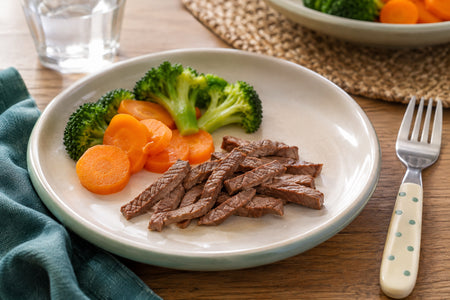
Rump rewards a marinade and thin slicing, while eye fillet needs little more than salt and a hot pan. Both suit quick high-protein dinner ideas such as steak salads and stir-fries.
Leaner Steak for High-Protein Meal Prep: Protein per Serve and Value

A 200g raw steak from any cut in the table supplies about 40g to 48g of protein, and rump gives the most protein per dollar of the stocked cuts compared below.
The figures below use AFCD's untrimmed raw values, closer to what you portion before cooking, and full box prices checked 18 October 2026. Porterhouse costs only 68 cents more per 100g of protein than rump.
| Cut and full box price | Protein in 150g / 200g raw | Energy in 200g raw | Cost per 100g protein |
|---|---|---|---|
| AMG rostbiff or whole rump, $26/kg | 30.0g / 40.0g | 1,092kJ | $13.00 |
| AMG porterhouse, $32/kg | 35.1g / 46.8g | 1,198kJ | $13.68 |
| AMG A Budget scotch cube roll, $39/kg | 33.6g / 44.8g | 1,502kJ | $17.41 |
| AMG tenderloin (eye fillet), $45/kg | 32.1g / 42.8g | 1,420kJ | $21.03 |
Costs are calculated on the whole primal before it is cut into steaks, so they do not allow for any fat you trim away at home.
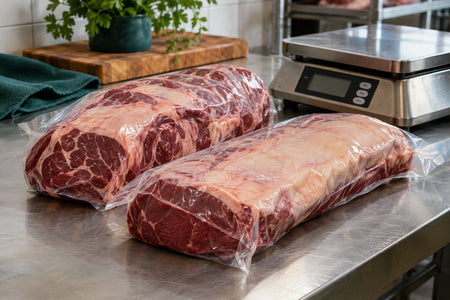
Box buying suits high protein meal prep: cut the primal into steaks, wrap or vacuum seal the portions and freeze what you will not cook while it is fresh, labelled with the date.
Rump strips also stretch further in stir-fries and rice bowls, one of the easiest ways to build cheap high-protein meals around beef.
Conclusion
By AFCD figures, the leanest steak cuts are trimmed round, sirloin and rump, while eye fillet trades a little more fat for tenderness.
Whichever you choose, trim the visible fat, cook it hot and fast, and stop at medium.
Grass-fed rump, rostbiff, porterhouse and eye fillet from Cost Cut Meats arrive chilled, never frozen, ready to portion.