
Working out how much meat per person is the difference between a table of happy guests and either an awkward shortage or a fridge crammed with leftovers. A good general guide is to allow around 250g of boneless raw meat or 350g of bone-in meat per adult for a main.
This guide gives you clear serving sizes in grams and kilograms for steaks, roasts, barbecues and catering, explains why raw weight matters more than you might think, and helps you buy the right amount with confidence.
The quick answer: standard serves at a glance
For a main course, plan on about 250g of boneless raw meat or 350g of bone-in meat per adult. That single rule covers most situations, and you only need to nudge it up or down depending on appetites, the cut, and how much else is on the table.
The figures below are raw weights, since that is what you buy. Most meat loses roughly a quarter of its weight during cooking, so a 250g raw serve lands closer to 190g on the plate.
| Situation | Boneless raw per adult | Notes |
| Everyday dinner | 200g to 250g | A light to standard main |
| Hearty meal or big eaters | 300g to 350g | Steak lovers and active appetites |
| Barbecue, mixed meats | 400g to 500g total | Across all the meats combined |
| Buffet or catering | 250g to 300g | When several dishes are served |
Meat per person by numbers: how many kilograms to buy
To scale up fast, multiply 250g by the number of guests for boneless cuts, or 350g for bone-in cuts. This is the quickest way to turn a headcount into a shopping weight without second-guessing yourself at the checkout.
Use the boneless column for steaks, mince, boneless roasts and diced meat, and the bone-in column for cuts like a leg of lamb, bone-in roasts or chops. Round up to the nearest pack size and treat any extra as tomorrow's lunch.
| Number of people | Boneless (about 250g each) | Bone-in (about 350g each) |
| 2 | 500g | 700g |
| 4 | 1kg | 1.4kg |
| 6 | 1.5kg | 2.1kg |
| 8 | 2kg | 2.8kg |
| 10 | 2.5kg | 3.5kg |
| 20 | 5kg | 7kg |
Serving sizes by cut

Different cuts carry different amounts of bone, fat and moisture, so the right portion shifts from one cut to the next. A lean fillet feeds more people per kilo than a fatty brisket that renders down as it cooks.
The table below is a practical starting point for the most common cuts. For slow-cooked cuts like brisket and pork shoulder, the bigger raw weight reflects how much they shrink, which our guide to slow-cooking beef in the oven explains in more detail.
| Cut | Raw per person | Good to know |
| Steak, boneless | 250g to 300g | Usually one steak per person |
| Roast beef, boneless | 250g | Add a little for leftovers |
| Roast beef or lamb, bone-in | 350g | The bone adds weight, not servings |
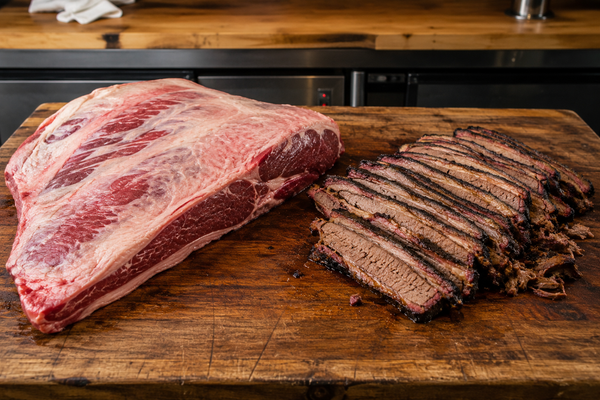
| Brisket | 400g to 500g | Can lose up to half its weight |
| Pulled pork, shoulder | About 400g | Yields roughly 200g cooked |
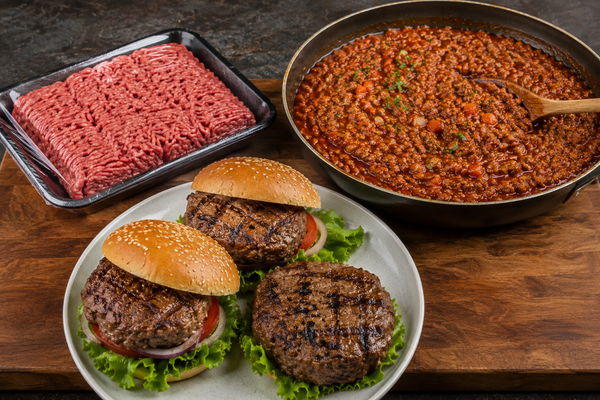
| Beef mince | 150g sauced, up to 250g standalone | Depends on the dish |
| Sausages | 2 to 3 per person | Around 150g to 200g |
| Chicken, bone-in | 350g | Breast fillet, 150g to 200g |
How much meat for a barbecue

For a barbecue, allow 400g to 500g of raw meat per adult across all the meats combined, not per type. The most common mistake is adding a full serve of sausages, a full serve of steak and a full serve of chicken, which leaves you badly over-catered.
When you serve several meats, reduce each one so the total lands in that range. A typical spread might be two sausages, a piece of steak and a skewer per person. Firm favourites like a good steak are worth prioritising, and our guide to the best steak for a BBQ covers the cuts that hold up best on the grill. Remember that sides such as bread, salads and corn fill plates too.
How much meat for a roast dinner
For a roast, allow 350g of bone-in meat or 250g of boneless meat per adult, then add a little for seconds and leftovers. A roast is a centrepiece, so most hosts happily size up for cold cuts the next day.
A bone-in leg of lamb or a standing rib roast needs the higher figure because the bone accounts for a real share of the weight. Boneless roasts such as a rolled scotch fillet carve cleanly with almost no waste, so the 250g figure holds. Whichever you choose, rest the meat before carving so the juices stay in rather than running onto the board.
Catering for a crowd: 10 to 100 people
When catering for a crowd with several dishes, drop each protein to around 200g to 250g per adult, since people spread their plates across the options. The more choice on the table, the less of any single dish each guest takes.
Decide first whether you are serving a plated main or a buffet, then scale from there. For large numbers it pays to buy in bulk, and our guide on how to buy meat in bulk and save helps you order efficiently.
| Guests | Plated main (about 300g) | Buffet, several dishes (about 200g each) |
| 10 | 3kg | 2kg |
| 20 | 6kg | 4kg |
| 50 | 15kg | 10kg |
| 100 | 30kg | 20kg |
Adjusting portions: kids, appetites and sides
Adjust the standard 250g serve up or down depending on who is eating and what else is on the table. A headcount alone rarely tells the whole story.
As a guide, count young children as roughly half an adult serve, at about 125g each. Add 100g per head for a hungry crowd or a meat-focused menu, and take off around 20 per cent when the sides are generous, since heavy salads, bread and potatoes do a lot of the filling. Teenagers often eat as much as adults, so plan for full serves there.
Buying the right amount without waste
Buy slightly more than your headcount suggests, then freeze the surplus rather than risk running short. A little extra costs far less than the stress of a table that runs out.
Meat portions well and stores well, so buying with a small buffer is smart rather than wasteful. If you are feeding a crowd on a budget, our roundup of the cheapest beef cuts that still taste great stretches the spend further. Anything you do not use will keep for months in the freezer, as our guide to how long you can freeze meat explains. When you are ready to order, you can browse the full range of cuts and have them delivered chilled.
Conclusion
Getting the portion right comes down to one figure: about 250g of boneless or 350g of bone-in raw meat per adult, adjusted for the cut, the occasion and the appetites at the table. Plan with the tables above, buy with a small buffer, and freeze what is left. When you need quality cuts delivered, Cost Cut Meats makes it simple.